
Anúncios
Have you ever stared at a cryptocurrency price chart, with its jagged lines and colorful bars, and felt completely overwhelmed? It’s a common experience for newcomers in the digital asset space. These charts seem to hold the secrets to market movements, but deciphering them can feel like trying to read an ancient, cryptic language. This visual complexity is the domain of technical analysis (TA), a discipline focused on forecasting future price action by studying past market data, primarily price and volume. It’s a powerful tool that can transform you from a passive observer into an informed participant.
At its heart, technical analysis is the study of market psychology expressed through data. Every trade, driven by human emotions like fear, greed, and hope, leaves a footprint on the chart. By learning to recognize the patterns these footprints create, traders aim to understand the collective sentiment of the market. Unlike fundamental analysis, which assesses a project’s intrinsic value, TA assumes that all known information is already reflected in the price. This makes it an invaluable skill in the crypto world, where market sentiment and momentum often have a more immediate and dramatic impact on price than underlying project developments.
Anúncios
This comprehensive guide is your navigator through the often-turbulent crypto seas. We will demystify the core components of technical analysis, starting with the very foundation: how to read candlestick charts and identify critical support and resistance zones. From there, we’ll dive into the essential indicators that professional traders use, such as Moving Averages, RSI, and MACD, and explain how to interpret their signals. Finally, we’ll show you how to combine these tools into a cohesive trading strategy, complete with robust risk management, to help you make more confident and disciplined decisions in your crypto journey.
Unpacking Technical Analysis: Why It Matters in Crypto
Ever looked at a crypto chart full of lines and bars and felt like you were trying to read a foreign language? You’re not alone, but that complex-looking display is the heart of technical analysis (TA). At its core, TA is a method used to forecast the future direction of prices by examining past market data, primarily price and volume. It’s less about a company’s balance sheet and more about the psychology of the market itself.
Anúncios
Think of technical analysis as reading the collective mood of traders. The patterns on a chart reflect the tug-of-war between buyers and sellers, driven by emotions like fear, greed, and optimism. By learning to identify these patterns, traders aim to make more informed decisions rather than just guessing. This practice is a cornerstone of many Cryptocurrency Trading Strategies for Beginners.
In the notoriously volatile world of digital assets, TA becomes an especially powerful tool. Unlike traditional stocks, crypto prices are often swayed more by market sentiment and momentum than by fundamental factors. Understanding chart patterns can help you navigate the dramatic swings, providing a framework for managing risk and spotting potential opportunities within the broader ebb and flow of Understanding Crypto Market Cycles.
Foundational Charting: Reading the Crypto Landscape
To navigate the crypto markets, you need a map, and that map is a price chart. While simple line charts can show you a trend, most traders rely on more detailed versions for effective technical analysis. The most popular of these are candlestick charts, which provide a rich, visual story of price action within a specific timeframe.
Learning to read these charts is the first step toward making more informed trading decisions. They pack a surprising amount of information into a simple shape. By understanding the language of charts, you can begin to interpret the market’s behavior and anticipate potential moves.
Mastering Candlestick Anatomy and Patterns
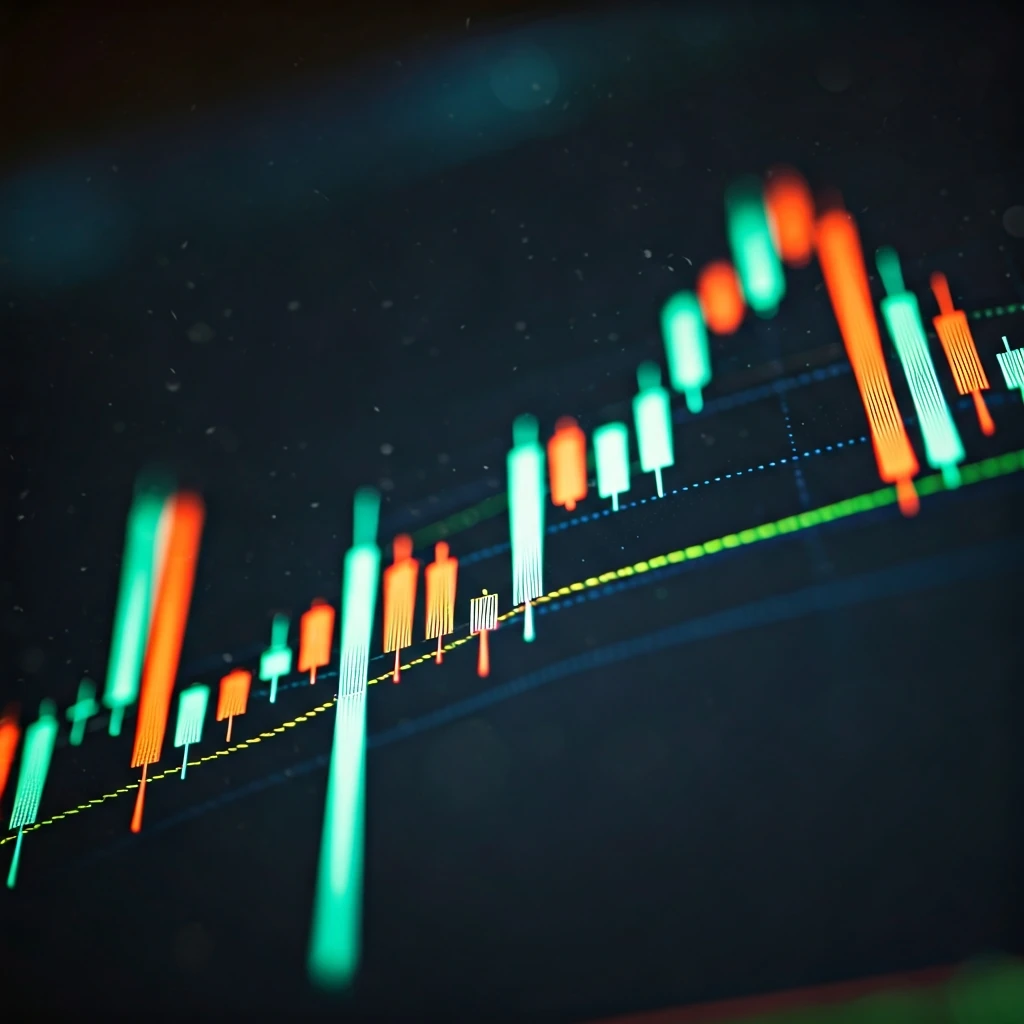
Each candlestick tells a story about the battle between buyers and sellers. The main, thick part is the “body,” which shows the opening and closing price for a period. The thin lines sticking out from the top and bottom, called “wicks” or “shadows,” represent the highest and lowest prices reached during that same period.
The color of the candle is your immediate clue to the market’s direction. A green (or white) candle typically means the price closed higher than it opened, a sign of buying pressure. A red (or black) candle means the price closed lower than it opened, indicating selling pressure was dominant for that timeframe.
When you string these candles together, they form candlestick patterns that can signal potential reversals or continuations of a trend. Formations like the “Doji,” “Hammer,” or “Engulfing” patterns are fundamental building blocks for many Cryptocurrency Trading Strategies for Beginners, offering clues about market sentiment.
Identifying Critical Support and Resistance Zones
As you watch price action unfold on a chart, you’ll notice that the price often struggles to move past certain levels. A price floor where a downtrend tends to pause or reverse is known as a support level. This is an area where demand is strong enough to absorb selling pressure and push prices back up.
Conversely, a price ceiling that an uptrend has difficulty breaking through is called a resistance level. This is a zone where supply is high, as sellers step in to take profits or open short positions, pushing the price back down. These levels are formed by historical price action, where the market has previously pivoted.
It’s helpful to think of support and resistance as zones rather than exact lines on a chart. The more times a price touches and bounces off one of these zones, the stronger it becomes. Identifying these key levels is a cornerstone of TA, as they help traders determine potential entry and exit points, aligning their short-term actions with the broader patterns detailed in Understanding Crypto Market Cycles.
| Concept / Indicator | Primary Use in Crypto TA |
|---|---|
| Candlestick Patterns | Visually represent price action and market sentiment to signal potential trend reversals or continuations. |
| Support & Resistance | Identify historical price levels where buying or selling pressure is expected to be strong, acting as potential turning points. |
| Moving Averages (MAs) | Smooth out price data to identify the underlying trend direction and generate buy/sell signals through crossovers. |
| Relative Strength Index (RSI) | A momentum oscillator that measures the speed and change of price movements to identify overbought or oversold conditions. |
| MACD | A versatile indicator that shows the relationship between two moving averages to identify momentum and potential trend changes. |
| Confluence | The practice of combining multiple indicators or patterns that point to the same conclusion, increasing trade confidence. |
Essential Indicators for Crypto Traders
While price charts provide the raw data, technical indicators act as your analytical tools, helping you interpret that data and make sense of market sentiment. These mathematical calculations are overlaid on a chart to provide deeper insights into price trends, momentum, and potential reversals. Think of them as different lenses, each offering a unique perspective on where the market might be heading next.
Trend Following with Moving Averages (MAs)
One of the most fundamental and widely used crypto indicators is the moving average (MA). It smooths out price action by creating a constantly updated average price over a specific time period. This helps to reduce market “noise” and makes it easier to identify the underlying trend direction. The two most common types are the Simple Moving Average (SMA), which gives equal weight to all prices, and the Exponential Moving Average (EMA), which gives more weight to recent prices, making it more responsive.
Traders often watch for “crossovers” as trading signals. A “golden cross” occurs when a shorter-term MA (like the 50-day) crosses above a longer-term MA (like the 200-day), often seen as a strong bullish signal. Conversely, a “death cross,” where the short-term MA crosses below the long-term one, is considered a bearish signal. Mastering MAs is a key component of many effective Cryptocurrency Trading Strategies for Beginners.
Momentum Mavericks: RSI and Stochastic Oscillator
Momentum indicators help you gauge the speed and strength of a price movement, identifying whether an asset is “overbought” or “oversold.” The Relative Strength Index (RSI) is a crowd favorite, oscillating between 0 and 100. A reading above 70 typically suggests an asset is overbought and may be due for a correction, while a reading below 30 suggests it is oversold and could be poised for a bounce. When you see discussions about RSI BTC analysis, this is the tool they are using to measure Bitcoin’s momentum.
Another popular tool is the Stochastic Oscillator, which compares a particular closing price of an asset to a range of its prices over a certain period. Like the RSI, it generates overbought (above 80) and oversold (below 20) signals. While both indicators measure momentum, the Stochastic is often considered more sensitive to recent price changes, making it useful for identifying short-term turning points.
Spotting Divergences with MACD
The Moving Average Convergence Divergence (MACD) is a versatile indicator that serves as both a trend-following and momentum tool. This is the essence of having MACD explained: it tracks the relationship between two EMAs of an asset’s price. The indicator consists of the MACD line, a “signal line” (an EMA of the MACD line), and a histogram that represents the distance between the two lines. Traders watch for the MACD line to cross above the signal line for a buy signal or cross below for a sell signal.
Bullish vs. Bearish Divergence
One of the most powerful ways to use indicators like the MACD and RSI is to spot divergence. A bullish divergence occurs when the price of a crypto asset makes a new low, but the indicator makes a higher low. This discrepancy suggests that the downward selling pressure is losing steam and that a potential trend reversal to the upside could be on the horizon.
Conversely, a bearish divergence forms when the asset’s price reaches a new high, but the indicator posts a lower high. This is a red flag for traders, signaling that the upward momentum is weakening despite the rising price. These signals can be early warnings of a potential market top and are invaluable for Understanding Crypto Market Cycles and identifying when a trend might be exhausted.
Strategic Approaches: Combining TA for Better Decisions
Using a single technical indicator can provide clues, but the real power of technical analysis (TA) comes from combining tools to build a more complete picture. Relying on just one signal is like navigating the ocean with only a compass; you know your direction, but you’re missing information about currents, wind, and depth. A strategic approach involves using multiple data points to confirm your trading ideas and manage your risk effectively.
Confluence: Validating Signals with Multiple Indicators
In trading, confluence is when two or more different analytical tools give you the same signal, creating a much stronger case for a potential trade. For example, you might notice that a cryptocurrency’s price is approaching a major resistance level on the chart. At the same time, the Relative Strength Index (RSI) moves into overbought territory, and a bearish candlestick pattern like an evening star forms. This confluence of signals provides a much higher-probability setup for a short position than any single indicator would alone.
The goal is to find agreement among your chosen tools. You could combine a trend-following indicator like a Moving Average with a momentum oscillator like the MACD. When the price crosses above the moving average (a bullish signal) and the MACD line crosses above its signal line (another bullish signal), the confluence strengthens your confidence in a potential upward move.
Developing a Personalized Trading Plan
Technical analysis is a tool, not a magic crystal ball. It functions best within a structured trading plan that outlines your goals, risk tolerance, and rules of engagement. This plan acts as your personal trading constitution, helping you make logical decisions instead of emotional ones. Your plan should define which indicators you will use, how you will combine them to find confluence, and the specific market conditions under which you will enter or exit a trade.
A crucial part of any plan is managing your own psychology. The fear of missing out (FOMO) or panic selling during a dip can wreck even the most well-researched TA strategy. A solid plan keeps you grounded, and resources on Cryptocurrency Trading Strategies for Beginners can provide a great foundation for building one. By defining your rules ahead of time, you reduce the chance that in-the-moment emotions will dictate your actions.
The Role of Risk Management in TA-Driven Trading
No matter how strong your analysis is, there is no certainty in the markets, especially with volatile assets like crypto. This is where risk management becomes the most important skill for any trader. Its primary purpose isn’t to guarantee winning trades but to ensure that losing trades don’t wipe out your capital, allowing you to stay in the game long enough to be profitable.
Effective risk management involves deciding how much of your capital you are willing to risk on a single trade, often expressed as a small percentage (e.g., 1-2%) of your total portfolio. Technical analysis plays a direct role in implementing this strategy by helping you identify logical points to limit potential losses and secure profits. This is done primarily through setting stop-loss and take-profit orders.
Setting Stop-Loss and Take-Profit Levels
A stop-loss is a pre-set order to sell a cryptocurrency when it reaches a certain price, limiting your loss on a trade that moves against you. A take-profit order does the opposite, automatically selling your position when it hits a specified price target to lock in gains. Using TA to set these levels is far more effective than picking arbitrary numbers.
- Setting a Stop-Loss: Use TA to identify key support levels, recent swing lows, or significant moving averages. Place your stop-loss just below these areas. If the price breaks through a strong support level, it’s a technical sign that your trade idea may be invalid, making it a logical point to exit.
- Setting a Take-Profit: Identify key resistance levels, previous swing highs, or Fibonacci extension levels. Setting your take-profit target just before these levels increases the probability of your order being filled before the market potentially reverses. This ensures you walk away with a profit instead of watching your gains evaporate.
Common Pitfalls and How to Avoid Them
While technical analysis is a powerful tool, it’s easy to fall into a few common traps, especially in the volatile crypto markets. A frequent mistake is relying solely on a single indicator, which can provide a skewed view of the market. For example, many indicators experience indicator lag, meaning they are based on past price action and may not reflect the market’s immediate direction, causing you to enter a trade too late.
Another major pitfall is overtrading, which is often driven by the fear of missing out (FOMO) on a fast-moving crypto asset. Seeing a chart pattern and feeling an immediate need to act can lead you to take low-probability trades that slowly drain your capital. Remember that not every pattern is a signal to trade; sometimes, the best move is to do nothing and wait for a clearer opportunity.
To mitigate these risks, always use a combination of indicators and timeframes to confirm signals. It’s also vital to pair your TA with a broader perspective, such as understanding crypto market cycles and the project’s underlying fundamentals. Adopting one of the many disciplined cryptocurrency trading strategies for beginners will provide the framework needed to avoid emotional decisions and trade with a clear plan.
Beyond the Charts: Integrating Fundamentals and Sentiment
While technical analysis (TA) is a powerful tool for decoding market movements, relying on it exclusively is like sailing with only a compass and no map. The most successful traders use a holistic approach, blending chart data with fundamental analysis and an understanding of market sentiment. This multi-faceted view provides crucial context that charts alone simply cannot offer, helping you make more informed decisions.
When Fundamentals Override Technicals
Fundamental analysis (FA) in crypto involves evaluating a project’s intrinsic value based on its technology, team, tokenomics, and roadmap. Think of it as doing your homework on the asset itself. A deep dive into a project’s core value, often starting with an Introduction to Blockchain Technology, can reveal strengths or weaknesses that aren’t yet reflected in the price chart.
Imagine a scenario where a chart shows a perfect bearish pattern, suggesting an imminent price drop. However, the project suddenly announces a major partnership with a global tech firm. This fundamental news can completely invalidate the technical signal, causing the price to surge as new buyers rush in. This is why understanding the project’s long-term potential and its position within the broader Understanding Crypto Market Cycles is so critical.
Gauging Market Sentiment with TA
Market sentiment refers to the overall mood or attitude of investors toward a particular asset or the market as a whole. While it seems intangible, certain TA indicators can act as a proxy for gauging this collective emotion. For example, extreme readings on oscillators like the Relative Strength Index (RSI) can indicate when an asset is heavily overbought (extreme greed) or oversold (extreme panic).
Volume is another key indicator that bridges TA and sentiment. A price breakout on high volume suggests strong conviction and participation from the market, making the move more reliable. Conversely, a breakout on low volume might signal a lack of enthusiasm and a higher chance of failure. Integrating sentiment analysis into your TA framework is a core component of many successful Cryptocurrency Trading Strategies for Beginners, as it helps you avoid buying at the peak of euphoria or selling at the bottom of a panic.
Mastering the Art and Science of Crypto TA
Navigating the cryptocurrency market with technical analysis is less about finding a magic formula and more about developing a disciplined skill set. It’s a powerful method for identifying probabilities, managing risk, and understanding market behavior, but it is not a crystal ball. The patterns and indicators discussed provide a framework for making educated guesses, not guarantees. The most successful traders understand that TA’s true strength is revealed when it’s integrated into a broader strategy that includes sound risk management, an awareness of market sentiment, and a grasp of fundamental drivers.
As you continue your journey, remember to treat technical analysis as an ongoing learning process. Start with the basics, practice identifying patterns on charts, and slowly incorporate indicators into your analysis. By combining these tools, developing a personal trading plan, and never risking more than you can afford to lose, you can move beyond emotional decision-making. You’ll begin to see the charts not as a source of confusion, but as a map of market psychology, empowering you to navigate the crypto seas with greater confidence and strategy.
Frequently Asked Questions About Crypto TA
Is Technical Analysis reliable for all cryptocurrencies?
Technical analysis is generally most reliable for cryptocurrencies with high trading volume and liquidity, like Bitcoin and Ethereum. For low-volume altcoins, charts can be more easily manipulated and patterns may be less dependable. Therefore, TA’s effectiveness can vary significantly from one digital asset to another.
How much capital do I need to start using TA for crypto trading?
There is no minimum capital requirement to start learning and applying technical analysis. Many platforms offer paper trading accounts that let you practice with virtual money. When you do start with real capital, it’s crucial to begin with a small amount you are willing to lose and focus on risk management and the learning process, not immediate profits.
What’s the difference between lagging and leading indicators?
Lagging indicators, like Moving Averages, are based on past price action and confirm a trend after it has started. They are useful for trend-following but can result in late entries. Leading indicators, such as the RSI or Stochastic Oscillator, attempt to predict future price movements and identify potential reversals, but they are prone to generating false signals.
Can TA predict market crashes or pumps?
TA cannot predict market events like crashes or pumps with certainty. Instead, it helps traders identify warning signs and probabilities. For example, a bearish divergence on the MACD or RSI might suggest that upward momentum is weakening, increasing the risk of a downturn. This allows traders to manage their risk proactively rather than predict the future.